December 22, 2012

On Ravaged Coastline, It’s Rebuild Deliberately vs. Rebuild Now

AnnMarie Willis and her husband, Bob, have decided to rebuild in Breezy Point
On Ravaged Coastline, It’s Rebuild Deliberately vs. Rebuild Now - NYTimes.com

(Excerpt)
The big thinkers have emerged in force since Hurricane Sandy. Environmentalists and academics call for a retreat from rising tides and vulnerable seashores. FEMA pores over flood photos, redefining the areas of highest risk. And city engineers and lawyers revisit building and zoning codes. All hope to ensure that whatever rises from the debris can survive future assaults by extreme weather.

But for all the policy debates, the actual decisions that will shape these communities are already being made by individual homeowners across New York and New Jersey, providing reason to be skeptical that any cohesive, unified vision of a rebuilt coastline will eventually emerge. Unable to wait for updated guidelines, let alone far-reaching plans — or unable to afford the new costs they may entail — many families and business owners are already acting in ways that will determine whether those more ambitious goals can be met.

Their responses range from faithful reconstruction to fatalistic retreat — and embody the essential tension of post-disaster recovery: rebuilding quickly, or rebuilding right.

City Rejects SFS and NBBL's Offer to Settle PPW Bike Lane Suit with New Traffic Safety Study

City Rejects SFS and NBBL's Offer to Settle PPW Bike Lane Suit with New Traffic Safety Study - Windsor Terrace-Kensington, NY Patch

(Excerpt)

Jim Walden, a lawyer representing NBBL and SFS, wrote Michael Cardozo a letter, the Corporation Counsel from New York City Law Department representing the NYC Department of Transportation, proposing to drop the suit if the DOT agrees to hire an independent expert to conduct an “objective study of traffic and safety impacts on Prospect Park West.”

If the study concludes that traffic and safety conditions have improved compared to the period before the bike lane was installed, “we will withdraw the lawsuit,” Walden’s letter read.

But, as Walden’s letter continues, if the study concludes that traffic and safety conditions have not improved, or in fact worsened, “then DOT will concede that the bike lane has failed to achieve its stated objective (calming traffic) and will remove it.”

Coney Island landlord cuts merchants a break

Coney Island landlord cuts merchants a break | Crain's New York Business

A Brooklyn developer is giving back to his storm-tossed stomping grounds.
Thor Equities CEO Joe Sitt is offering to cut rents for four storefronts he owns on Coney Island by 40%. The idea is to lease the spaces to local Brooklyn merchants ahead of the 2013 beach season.
The spaces are small storefronts on the corner of Surf and Stillwell Avenues. Market rate rent would usually be between $50 per square foot and $125 per square foot.
A Thor Equities spokesman noted that Mr. Sitt is from the Coney Island area and that he wanted to make sure his part of Brooklyn didn't get overlooked in recovery efforts. Though the area has recently seen a major revitalization, those efforts were set back by Superstorm Sandy. But as Coney Island cleans up and rebuilds for next year Mr. Sitt wants to do his part.
"South Brooklyn doesn't have all the same amenities that North Brooklyn has now," said the spokesman. "So we want to see who we can get for a really exciting 2013 season."

December 20, 2012

For Hospitals In Flood Zones, Planning Of Infrastructure Now Vital » Sheepshead Bay News Blog

Sheepshead Bites » Blog Archive For Hospitals In Flood Zones, Planning Of Infrastructure Now Vital » Sheepshead Bay News Blog


For Minor Crimes, NYers Sentenced to Sandy Relief

For Minor Crimes, NYers Sentenced to Sandy Relief - ABC News

(Excerpt)
New Yorkers who got into minor trouble in Manhattan have been sentenced to Sandy.

Last week, 70 people who were given community service after pleading guilty to infractions like public drunkenness, open container violations or speeding were shuttled to Coney Island in Brooklyn to help with cleanup efforts after the devastating storm.

They raked leaves, shoveled mud and picked up garbage and debris. More than 1,000 bags of trash were collected in 732 hours of work. Swaths of Sandy-wrecked filthy streets and sidewalks were cleaned.

Sandy-Damaged Totonno's Pizza On Coney Island Still Struggling To Reopen

121912totonnos.jpgSandy-Damaged Totonno's Pizza On Coney Island Still Struggling To Reopen: Gothamist


Among the many restaurants and businesses struggling to recover after Hurricane Sandy is @Totonno's, the legendary Coney Island pizzeria that has been slinging pies since 1947. The restaurant took in four feet of seawater on the night of the storm, heavily damaging the floors, walls, machinery and infrastructure. Slice took an in-depth look at the pizzeria's rebuilding efforts and revealed the extent of the damage and how construction efforts have been hampered by unreliable contractors and the expense of the project.

@Antoinette Balzano, 3rd-generation owner of Totonno's and granddaughter to original owner Antonio "Totonno" Pero, told Slice she waited five weeks before anyone even showed up to survey the damage and make an assessment. Before then, Antoinette had been working at the pizzeria daily without heat or electricity, "where particles in the air made her cough and chairs were stacked up after having been tossed around like toys from a Barbie tea party," as described by the Times. When a company finally did come to check for growing mold, they bailed after just taking down the walls, asking for $6,000 in the process. Mold removal is just one of the expenses facing Totonno's, which is still waiting on a $150,000 loan to cover the cleanup and rebuilding process. Additionally, they face replacing both the air conditioning and heating units ($8,000 each), each purchased after the 2009 fire; retiling the oven ($5,000); plumbing and electrical work; replacing the Hobart mixer ($20,000), range, walk-in, and all other kitchen equipment, and repairing damaged portions of the walls.

All told, Antoinette expects total repairs to cost more than $100,000, a seemingly insurmountable cost considering the restaurant is still working to pay off debt from the 2009 fire that ravaged the building and closed the pizzeria for almost a year. They also recently discovered that their insurance—which covers interruption of business but not flood—will not reimburse them for anything. "These days, people would probably tell me, 'Antoinette, give up.' But I can't," Antoinette confided to Serious Eats. "All I do is go home to do my work and prepare for tomorrow."

While time and money may be able to repair the restaurant's structure, nothing can replace the family memorabilia—including Christmas decorations that belonged to Antoinette's grandfather—that served as a visual timeline of the pizzeria's 88-year history. Luckily, loyal fans of the pizzeria have stepped up to offer their services, from contractors to electricians to a carpenter offering to fix a family heirloom, all at greatly reduced costs. "We can't compromise the sentimental value. We want to make sure everything seen by the public remains the same," explained Rocco Ranaudo, the current contractor.

Totonno's hopes to re-open by mid-January

December 19, 2012

Plastic planks approved for Coney Island boardwalk

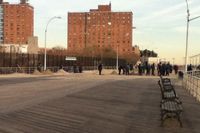
Coney Island boardwalk needs a makeover (Photo by Allan Shweky)
Plastic planks approved for Coney Island boardwalk - NYPOST.com


Plastic is the new wood, a judge has decided — at least when it comes to Coney Island’s boardwalk.

Brooklyn Supreme Court Justice Martin Solomon has green- lighted the city’s plan to replace five blocks of the historic — but rickety — structure with concrete and recycled-plastic planks, according to court documents made public yesterday.

Some Brooklynites were quick to slam the decision.

“The Coney Island boardwalk is nostalgic, and it’s famous world-round,” fumed Todd Dobrin, president of a group called Friends of the Boardwalk.

“I don’t think tourists are going to come to see the Coney Island driveway.”

The Coney-Brighton Boardwalk Alliance sued in June, asking the court to order the city to conduct an environmental review before replacing even one wooden plank.

Solomon sided with the Bloomberg administration, which insisted no review was necessary.

“We are pleased the judge found that the Parks Department complied with the law, thus allowing this project to proceed,” said Katie Kendall of the city Law Department.

The project would replace 50,000 square feet — about 5 percent — of the boardwalk on five blocks between Brighton 15th Street and Coney Island Avenue.

Solomon may have signaled his opinion at an October hearing when he hammered an attorney representing the alliance.

“I would say I know a little more about this than you do,” the judge, a former state senator from Bensonhurst, snapped.


Geoffrey Croft, president of NYC Park Advocates, said he knew at that point he was fighting for a lost cause.

“The plaintiffs definitely felt that just from the judge’s demeanor that they weren’t going to get a fair shake,” Croft said.

“Sooner or later, the whole thing is going to be made of concrete. It’s a boardwalk; it’s not a sidewalk.”

Croft added that he had some concrete reasons for preferring wood.

Cement, he noted, “holds in the heat, and in the winter, it’s going to ice up and be slippery.”

Speaking of Sandy and its destruction of the Rockaways boardwalk, he remarked, “Of the areas that had jetties, the damaged concrete boardwalks were as impacted as the wooden ones.”

Ida Sanoff, a plaintiff, agreed.

“Those of us who live on the shoreline are very concerned about this,’’ she said. “This has nothing to do with memories or sentimentality. This has to do with safety. ‘’

Mayor Bloomberg, on the other hand, hardened his anti-wood position after the superstorm.

“I guess this settles the issue of wooden boardwalks versus concrete boardwalks,” he told a local newspaper after Sandy.

“There will be no more wooden boardwalks in Rockaway or anywhere else.”

Additional reporting by Rich Calder

A Brooklyn judge yesterday signed off on the city’s use of recycled-plastic planks — instead of wood — in restoring rickety parts of the Coney Island boardwalk.

* Project would replace 50,000 square feet of the boardwalk — about one-twentieth of its length — between Brighton 15th Street and Coney Island Avenue.

* Could serve as model for the entire 42-block boardwalk, except for the amusement area.

* City says any delay would have cost more than $7 million in grant money.

December 18, 2012

More Young Americans Are Homeless

More Young Americans Are Homeless - NYTimes.com
(Excerpt)

Across the country, tens of thousands of underemployed and jobless young people, many with college credits or work histories, are struggling to house themselves in the wake of the recession, which has left workers between the ages of 18 and 24 with the highest unemployment rate of all adults.

Those who can move back home with their parents — the so-called boomerang set — are the lucky ones. But that is not an option for those whose families have been hit hard by the economy, including Mr. Taylor, whose mother is barely scraping by while working in a laundromat. Without a stable home address, they are an elusive group that mostly couch surfs or sleeps hidden away in cars or other private places, hoping to avoid the lasting stigma of public homelessness during what they hope will be a temporary predicament.

December 17, 2012

Concrete And Plastic Coney Island Boardwalk Gets Green Light From Judge

Sad day for old boardwalk screws
Concrete And Plastic Coney Island Boardwalk Gets Green Light From Judge: Gothamist


A Brooklyn judge ruled that the city Parks Department can replace a section of the Coney Island boardwalk with concrete and plastic without an environmental review. The plan to eventually replace most of the boardwalk with artificial materials has been bitterly contested by a small but dedicated group called The Coney-Brighton Boardwalk Alliance, which filed a lawsuit against the city to stop the plan to replace a five block section of boardwalk, from Brighton 15th Street to Coney Island Avenue.
Judge Martin Solomon ruled that the renovation "does not involve substantial changes to the existing structure. The footprint of the boardwalk will remain the same and the substructure will be replaced with artificial materials. Second, it is a replacement or repair of the structure in kind albeit with artificial materials in addition to natural wood." Solomon also decided that artificial materials do not "constitute an impairment of the character or quality of important historical, archeological, architectural, or aesthetic resources or of existing community or neighborhood character." In his ruling, he said the changes were similar to replacing an athletic field with artificial turf, which is not subject to environmental review.

Rob Burstein, one of the most outspoken wooden boardwalk preservationists, tells us, "We're disappointed and our attorneys are reviewing it. We believe that especially in light of the damage from Hurricane Sandy, a full moratorium on concrete and plastic sections is urgently needed for the safety of the community. And in our opinion a full environmental impact study should be mandated prior to any design or construction, especially in light of the damage caused by Hurricane Sandy."
We asked Burstein about Mayor Bloomberg's recent assertion that Hurricane Sandy put the nail in the coffin for wooden boardwalks. (In an interview last month, the mayor said, "I guess this settles the issue of wooden boardwalks versus concrete boardwalks. There will be no more wooden boardwalks in Rockaway or anywhere else.") But Burstein isn't buying it—he tells us:

"Contrary to Bloomberg's claims that in the Rockaways the concrete boardwalk sections fared better than wood sections, that is not in fact the case. Most media have not covered it, but both concrete and wood were either demolished or left sanding solely depending on whether they were to the east or the west of Beach 86th Streets. There were no rock jetties to the west, where boardwalk sections—both wood and concrete—were demolished. However, there were rock jetties to the east that helped the boardwalk, whether wood or concrete, remain intact."

Geoffrey Croft, president of NYC Park Advocates, also dismissed Bloomberg's statement as "greatly misinformed." Now wooden boardwalk advocates are worried that changes to this five-block section of boardwalk will serve as a blueprint for a completely synthetic boardwalk—and the mayor's declaration would seem to support that theory. Burnstein says, "Whether it's Bloomberg's ignorance or his purposeful use of the hurricane to further the use of concrete, it's sad that it's being done when it's not based on facts."
Read also:
NY Times article on boardwalk controversy February 2012

December 16, 2012

The City's Lowest Household Median Income Neighborhood

A Glimpse Into the City's Lowest Household Median Income Neighborhood - WNYC
(Excerpt)
A Coney Island neighborhood that stretches along the waterfront is where the city's lowest median household income residents can be found. According to the Census Bureau's American Community Survey, households here take in around $9,500 a year.

Featured Post

Icy Water Surround Manhattan

View this post on Instagram A post shared by Little Kid Big City NEW YORK (@littlekidbigcity_newyork)

Most Viewed Posts for last 30 days